Journal
Istanbul's most beautiful domes

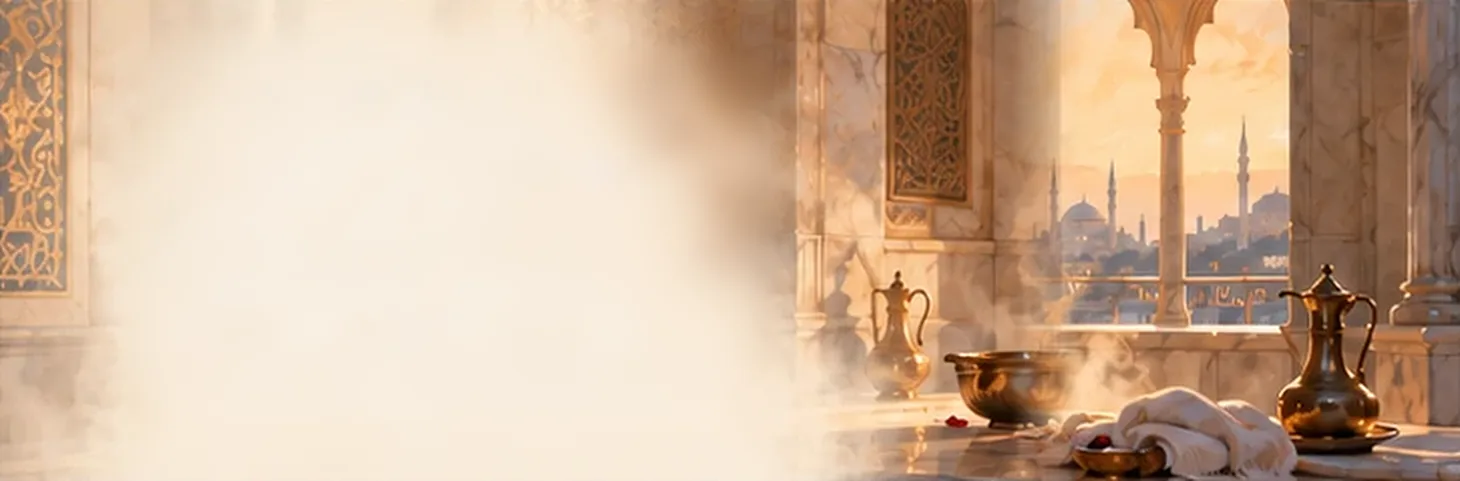
Lie back on the warm marble of an Istanbul hamam and look up. Above you, a dome rises out of the steam, pierced by dozens of small glass openings. Daylight falls through them in narrow beams, and as the steam drifts, the beams move. It is one of the most beautiful sights in the city, and many visitors only notice it halfway through their bath.
A city written in domes
Istanbul's skyline is a conversation between domes. The great dome of Hagia Sophia, completed in 537, set a standard builders measured themselves against for a thousand years. When the Ottomans took the city in 1453 and made it their capital, they inherited that ambition and turned it to mosques, schools, fountains and bathhouses.
The hamam itself has a long lineage. Its sequence of cool, warm and hot rooms descends from the Roman baths. The Ottomans kept the heat and the steam but left out the plunge pools, preferring water that flows: poured from a basin, never sat in. The dome suited this kind of bathing perfectly. It gathers warm air, lets condensation run down its curve instead of dripping onto bathers, and gives the hot room its soft, echoing hush.
Mimar Sinan, architect of light and water
No name matters more to Istanbul's domes than Mimar Sinan. Born in central Anatolia in the late fifteenth century, he served as a military engineer before becoming chief royal architect in 1538, a post he held for about half a century under three sultans. He is credited with hundreds of buildings, including dozens of bathhouses.
Sinan's genius was structural as much as decorative. He kept experimenting with how a dome could rest on a square or many-sided room, and how to carry its weight down so the walls could open up for windows. He is said to have summed up his career in three buildings: an apprentice's work, a journeyman's, and finally his masterpiece in Edirne. The hamams he designed carry the same thinking on a more intimate scale: clear proportions, generous light, and domes that seem to float.
Fil gözü: stars in the ceiling
The small glass openings in a hamam dome are called fil gözü, which translates as "elephant's eye". Each is a thick glass lens or a tiny glazed cap set into the masonry. They solve a real problem: bringing daylight into a room that must hold its heat and steam. Ordinary windows would cool the room; these small lenses let light in and lose very little warmth.
They are arranged in rings, stars or radiating patterns, and on a bright day the effect is extraordinary. Late morning and early afternoon, when the sun is high, are the best hours to see it. In the steam, the light separates into visible shafts.
How to read a hamam dome
Once you know what to look for, every hamam becomes more interesting:
- The transition. Look at where the walls meet the dome. A square room has to become a circle, and Ottoman builders managed it with squinches, pendentives, or a belt of folded triangles often called "Turkish triangles". Some hamams fill these corners with muqarnas, the honeycomb-like carving of Islamic architecture.
- The hierarchy of domes. The entrance hall, the camekan, often has the largest dome, sometimes crowned by a small lantern. The hot room is lower, to hold its heat, and the private halvet chambers in its corners have tiny domes of their own.
- The marble. The göbektaşı, the heated marble platform, sits directly beneath the main dome. Lying on it puts you at the point the whole room was designed around.
- The heat below. Historic hamams were warmed from underneath: a furnace, the külhan, heated the water and sent hot air through channels beneath the floor. The warmth you feel through the marble is that system at work.
Hamams and the life of the city
Many historic hamams belonged to a charitable endowment, built alongside a mosque or a school, with the bath's income helping to support the whole complex. A double hamam, or çifte hamam, had mirrored sections for men and women under separate domes, often with entrances on different sides of the building. Old Istanbul neighbourhoods are full of these low domes: some still working, some converted, some lost.
Several historic hamams in Istanbul still welcome bathers today, many after careful restoration that brought back their marble and their light. Bathing in one is the most direct way to experience Ottoman architecture: not as a monument behind a rope, but as a working room built for the body.
Seeing the domes for yourself
Book a daytime visit if you can, and give yourself time on the warm stone before the kese begins. That is when you will notice the light. A private ritual helps: with fewer people around, you can lie still, look up and let the dome do what it was built to do.
Our concierge arranges private rituals for two in Istanbul. New to hamams? Read what to expect in your first Turkish hamam and our guide to hamam etiquette for couples.
Frequently asked questions
Who was Mimar Sinan?
Mimar Sinan was chief architect of the Ottoman Empire from 1538 for about fifty years. He is credited with hundreds of buildings, including dozens of hamams, and shaped much of Istanbul's historic skyline.
What is a fil gözü in a hamam?
Fil gözü, meaning "elephant's eye", are the small glass lenses set into a hamam's dome. They let daylight in while keeping heat and steam inside.
When is the best time to see the light in a hamam dome?
On a bright day, from late morning to early afternoon. The beams show best when there is steam in the air.
Are Istanbul's historic hamams still in use?
Yes. Several historic hamams still operate as working baths, many after careful restoration.
Plan your ritual
Our concierge arranges private hamam rituals for two in Istanbul, with Bodrum, Cappadocia and Antalya opening soon.